
 Switch
 Homepage
 facebook
 IG
IG
 Other Hospital
 CMUH App
Laboratory Medicine | Excellence
Excellence
Precision Medicine has long been the ultimate goal pursued by every clinical healthcare professional, aiming to use the best diagnostic results to implement the most personalized and effective treatment for each patient. With the rapid development of next-generation sequencing (NGS) technologies and related tools, we have entered a new era where individual genomic and epigenomic differences guide disease treatment strategies.
By leveraging the vast genomic data generated from NGS, combined with traditional laboratory tests, clinical examinations, and long-term accumulated information—including personal lifestyle and environmental factors—clinicians can make the most accurate diagnoses and determine the optimal treatment for each patient, achieving the goals of precision medicine.
Our department began focusing on genomics-based testing in 2015, and in 2016 we established a Bioinformatics Unit dedicated to the processing and integration of large-scale data. Over the years, we have expanded precision diagnostic services across multiple areas, including cancer, rare genetic disorders, prenatal testing, infectious diseases, and disease risk assessment, while accumulating extensive clinical application experience.


1.Whole Exome Sequencing (WES)
Whole Exome Sequencing examines all protein-coding genes in the human genome, approximately 23,000 in total. About 85% of human diseases are associated with protein-coding genes, which represent only around 2% of the entire genome. Therefore, WES can detect roughly 85% of human diseases and is currently one of the most effective testing methods for diagnosing unknown or rare conditions.
2.Pan-Cancer Genomic Testing
This test analyzes 275 genes that commonly harbor mutations across all cancer types. These genes are associated with cancer development and are relevant to treatment decisions and prognosis. In addition to providing guidance for patient therapy, the test can also suggest new treatment options for patients who respond poorly to standard therapies.
3.Cancer Type-Specific Genomic Testing(NGS)
Using next-generation sequencing , this test targets genes associated with specific cancers, including lung cancer, acute myeloid leukemia, colorectal cancer, and breast cancer. Results not only serve as a guide for targeted therapy, but patient-specific mutations can also act as prognostic biomarkers. These biomarkers are more specific, sensitive, and precise than traditional protein-based markers.
4.Gut Microbiome Testing
This test analyzes the diverse bacteria present in the human gut. Maintaining a balanced gut microbiota is essential for preventing diseases, as many conditions have been linked to microbial imbalance, including obesity, metabolic disorders, and immune-related diseases.
5.Non-Invasive Prenatal Testing (NIPT)
This test detects small amounts of fetal cell-free DNA (cffDNA) in maternal blood. It provides risk assessment for aneuploidies in the 22 pairs of autosomes and sex chromosomes, as well as screening for up to 66 microdeletion syndromes.
6.Disease-Associated Gene Testing
This test analyzes genes related to specific diseases. While environmental factors can contribute to disease, most are influenced by genetics. Diseases may result from a single-gene mutation, multiple genes, or the combined effect of several genes. This testing method comprehensively examines all genes associated with a particular disease to provide a complete genetic assessment.

Although human genomes are highly similar, each individual’s genetic sequence is unique. Precision medicine aims to leverage these individual differences for diagnosis, treatment, and monitoring. Advances in human genome sequencing and next-generation sequencing (NGS) technologies have made precision genetic testing possible, with bioinformatics at its core—using applied mathematics, information science, statistics, and computer science to analyze and solve complex biological problems.
The Clinical Laboratory at China Medical University Hospital was the first to establish a Bioinformatics Unit dedicated to clinical applications. This unit implements an integrated workflow covering sample collection, laboratory testing, and bioinformatics analysis. With dedicated analytical servers, data transfer time is minimized and patient data security is enhanced. Developing and adjusting analysis technologies in-house reduces reliance on external biotech companies.
Short-term goal: Develop an automated NGS analysis and reporting platform for clinical applications, accelerating analysis and reducing reporting time.
Medium-term goal: Integrate and construct a comprehensive biomedical big data repository, including extensive DNA sequences and clinical data.
Long-term goal: Utilize artificial intelligence and machine learning to develop automated interpretation systems for precision medicine.
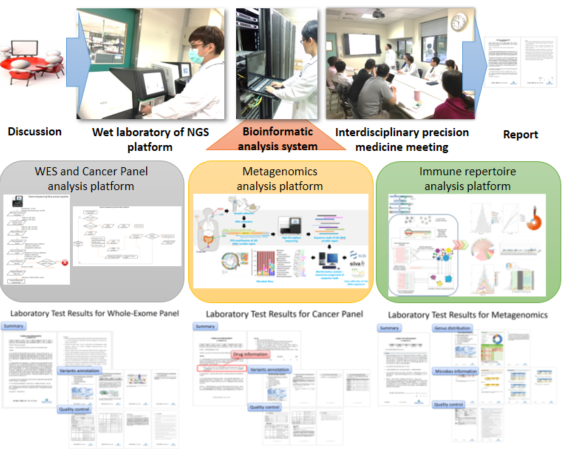
One-Stop Laboratory Workflow & Bioinformatics Unit Short-Term Goals
Our sequencing platform and hospital systems run on separate networks to protect patient data. Resources include computing, storage, and web servers, with firewalls and RAID technology ensuring data security and recovery in case of hardware failure.

IT System Structure
 Facebook
 IG
IG
 YouTube