
 Switch
 Homepage
 facebook
 IG
IG
 Other Hospital
 CMUH App

Scald burns (like hot water and hot soup)
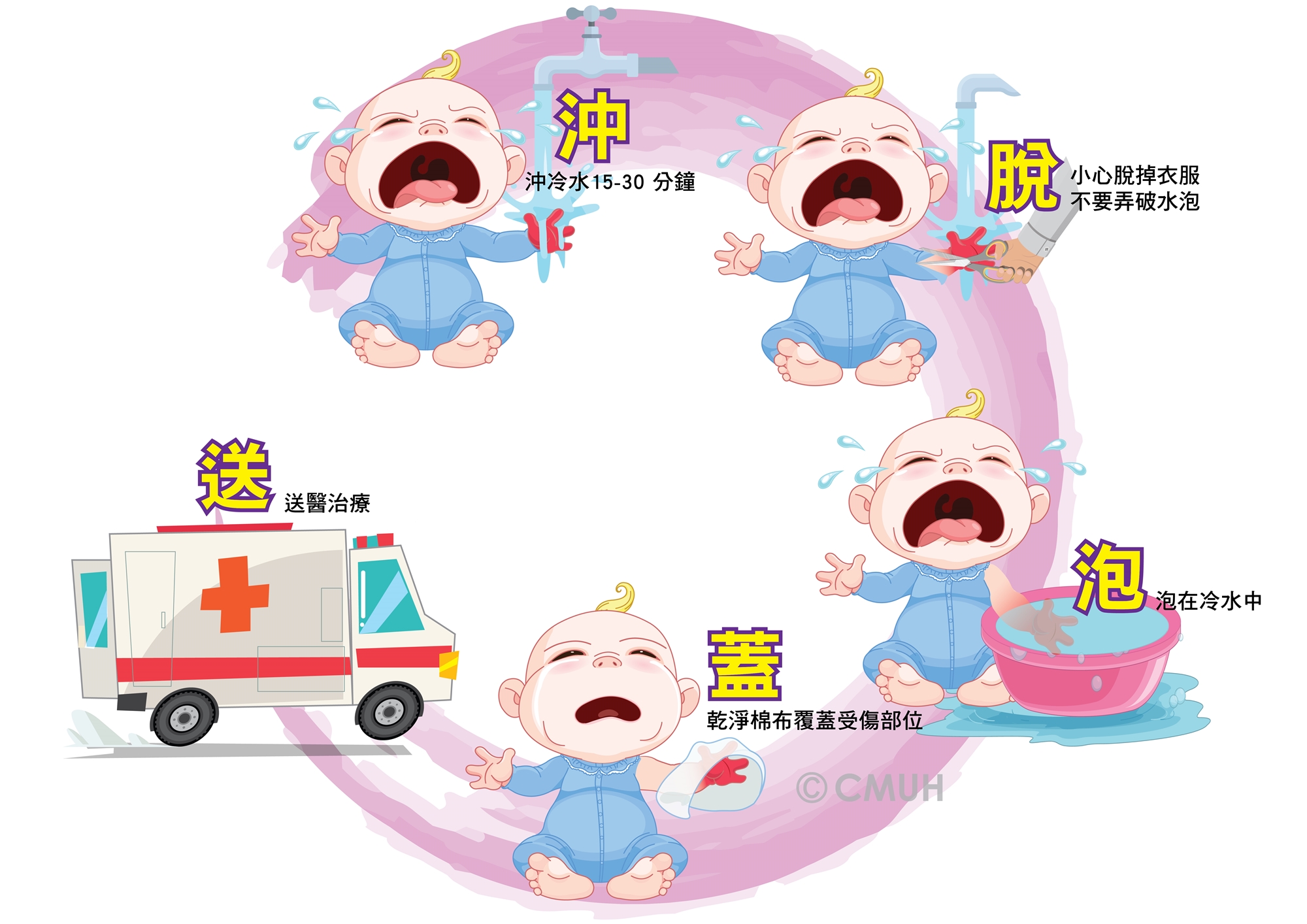
- Rinse: Put the injured wound in the cold water or flush by water continuing for 20 minutes to lower the temperature of the skin surface.
- Off: Let the clothing on the body totally wet, take it off carefully and avoid breaking apart the blisters. Carefully remove all tight clothing/jewelry (e.g., rings) before the injured area swells.
- Dip: After taking off the clothes, then dip the injured skin under the water to relief the pain. If the wound area is too large or the age is small, then do not dip the wound to prevent the complication such as arrhythmia that caused by extremely low body temperature.
- Cover: Use clean cotton cloth that is wetted by boiled cold water to cover the injured skin. Keep the wound clean and do not apply anything over the wound to prevent wound infection.
- Delivery: Send to the nearby hospital as soon as possible for further management.
Flame burns
- If the body is on fire, use the both hands covering the face immediately then lying down with rolling the body or cover by a large piece of blanket. After extinguishing the fire, then follow the emergent treatment processes as scald burns listed as above.
- Do not busy running when catching on fire, or it may just encouraging the fire due to air supplement.
Contact burns
In general, it belongs to low-grade bun injuries
- Gently rinse the burn injury site by water or put it in the cold water for 20 minutes, until the pain subsides. If it cannot be rinsed or dipped, then use ice packing.
- Before wound swelling, take off rings, belt, shoes or tight clothing carefully.
- Use dressings and wrap the wound if needed.
- Do not use adhesive dressings
- Do not apply lotion, ointment or oil over the wound
- Do not break apart the blisters, peel the injured skin or interfere with the skin wound
Chemical burns
- Regardless of the chemical composition pH, the injured area must be immediately irrigated with copious amounts of running water. The irrigation should continue for 1 to 2 hours, or until the burning sensation ceases, to reduce the concentration of the chemical agent on the skin surface. When rinsing, ensure to avoid washing the chemical over unaffected skin. If the chemical is a powdered agent, it should first be carefully brushed from the skin before irrigation is initiated.
- If the face, particularly the eyes, is affected, the eyes should be opened and irrigated with copious amounts of running water to dilute the concentration. When irrigating, always ensure that the unaffected eye is uppermost to avoid contamination.
Electrical burns
- Electrical burns are skin injuries caused by electrical resistances that are produced by he electrical flow passing through the body tissue. The severity is based on the time and circuit which electrical flow pass through the body. If the heart and respiratory center are damaged, then cardiac arrest or respiratory arrest may happen. And if the cranial nerves are in juried, it may cause consciousness disturbance and even death.
- Before the resuscitation, be sure that the power is turned off. If respiratory and cardiac arrests are found, the artificial respiration and cardiopulmonary resuscitation should be done simultaneously and transfer to the hospital immediately.
- In general, the involvement of electrical burns is deeper so that you can skip the rinse process and transfer to hospital immediately, except it is injured by electrical pot.
 Facebook
 IG
IG
 YouTube