
News & Message
Recrudescent severe malaria due to Plasmodium falciparum following treatment in a Taiwanese patient: a case report

Abstract
Background
Severe malaria caused by Plasmodium falciparum remains a life-threatening disease, particularly in non-immune individuals returning from endemic regions. While prompt treatment can usually achieve parasite clearance, recrudescence after initial recovery is rare and presents unique diagnostic and management difficulties. This report documents a case of recrudescent severe malaria in a Taiwanese traveller, highlighting the complexity of managing in the setting of multi-organ failure, even with guideline-based therapy.
Case presentation
A previously healthy 66-year-old Taiwanese man developed fever, vomiting, diarrhoea, and jaundice shortly after returning from multiple Central African countries with high malaria prevalence. His condition rapidly deteriorated to multi-organ failure, including acute kidney injury, liver failure, thrombocytopenia, and respiratory distress. Blood smear microscopy revealed a high parasitaemia (20%) due to P. falciparum, which was confirmed by real-time PCR.
Management and outcome
The patient received intravenous artesunate and oral artemether-lumefantrine, in addition to haemodialysis and plasma exchange as supportive therapies. Initial treatment achieved parasite clearance and clinical improvement. However, four weeks later, the patient experienced recrudescence with recurrent fever, anaemia, and return of parasitaemia. The therapeutic regimen was then revised to artesunate combined with doxycycline and clindamycin, followed by oral artemether-lumefantrine. This approach led to successful parasite clearance within two weeks and complete recovery, with no further recurrence observed during follow-up.
Conclusions
This case highlights that even with prompt, guideline-based therapy and the absence of pfk13 mutations, severe P. falciparum malaria in non-immune individuals can still develop recrudescence. Enhanced clinical vigilance, laboratory monitoring, and multidisciplinary care are essential for management. Reporting such rare recrudescent cases supports clinical awareness, informs best practice, and strengthens public health preparedness in low-incidence regions.
Keywords :Recrudescence, pfk13 mutations, Plasmodium falciparum, Schizont, Plasma exchange therapy
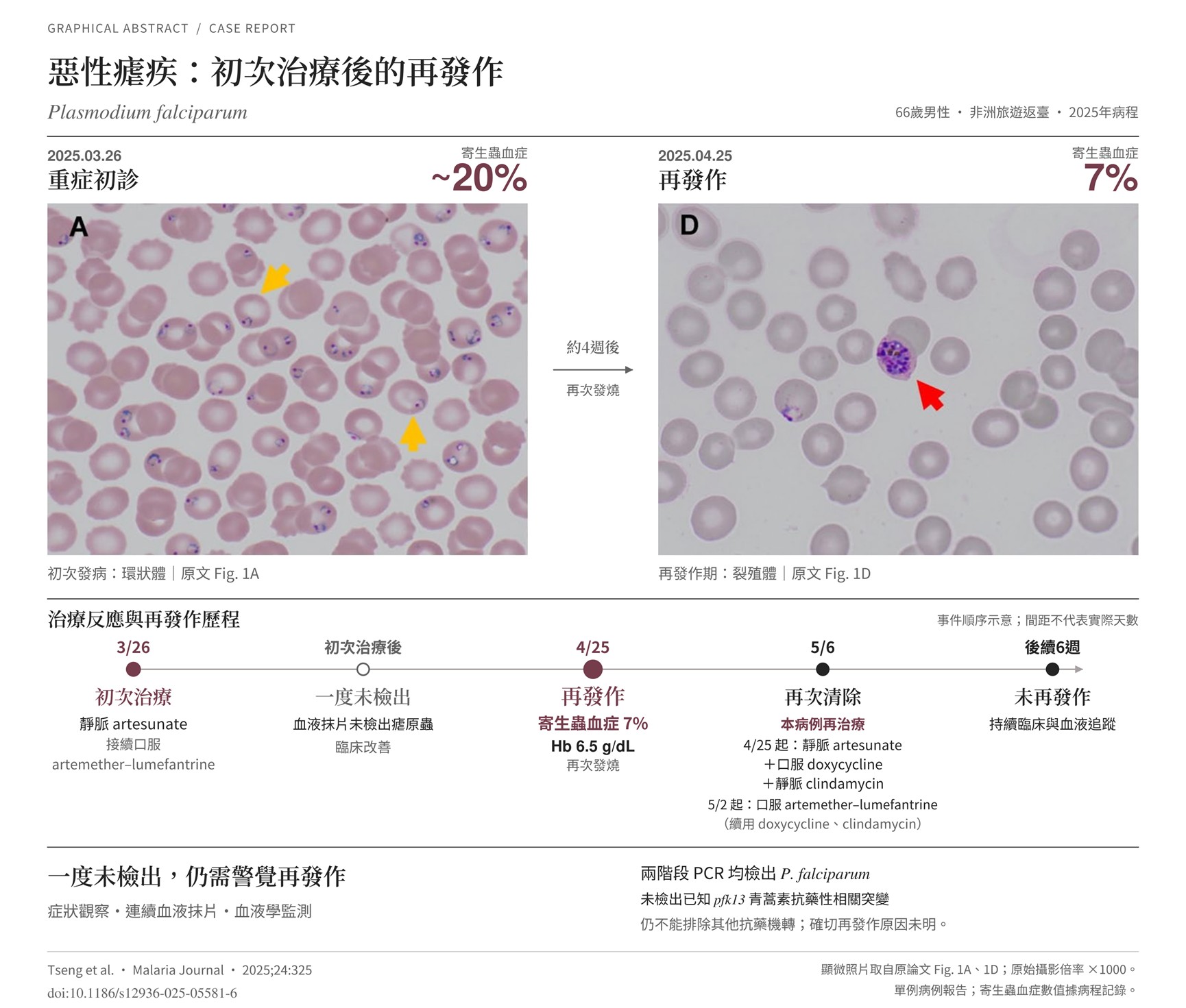
本病例報告記錄一名66歲台灣男性,赴非洲旅遊前未使用瘧疾預防藥物,返台後確診惡性瘧原蟲(Plasmodium falciparum)感染,初期寄生蟲血症達約20%,並合併急性腎損傷、肝功能衰竭、嚴重血小板低下與呼吸窘迫。患者接受靜脈 artesunate、後續口服 artemether–lumefantrine 及透析等器官支持治療後,病況一度改善,血液抹片亦未再檢出瘧原蟲;然而,初次治療約四週後再次出現發燒與嚴重貧血,寄生蟲血症回升至7%,臨床評估為瘧疾再發作。團隊透過連續血液抹片監測病程,並結合即時PCR與 pfk13 基因分析,進行病原確認及抗藥性相關評估。經調整治療後,患者於兩週內再次達到寄生蟲清除,後續六週追蹤未再發作。雖未檢出已知與青蒿素抗藥性相關的 pfk13 基因突變,但由於抗藥性分析僅限於此基因,且未測定抗瘧藥物濃度,本例再發作的確切原因仍未釐清。本報告呈現重症瘧疾在多重器官功能障礙下的診療挑戰,強調初期病況改善後仍需持續追蹤,並凸顯旅遊史辨識、連續血液抹片監測,以及臨床、檢驗與公共衛生單位合作的重要性,為台灣處理境外移入重症瘧疾提供實務參考。
相關文章


 開關
 首頁
 Facebook
 Instagram
 體系醫院
 中國醫點通