
News & Message
Cyclospora cayetanensis infection: current insights into foodborne outbreaks, diagnostic challenges, molecular epidemiology, and future directions

Abstract
Cyclospora cayetanensis causes prolonged or relapsing watery diarrhea and is an important cause of foodborne outbreaks, most often associated with contaminated fresh produce. Recent multistate outbreaks in the United States have highlighted how short product shelf life, complex supply chains, incomplete ingredient-level exposure data, and limited availability of implicated foods hinder timely source attribution. This review examines foodborne outbreak epidemiology, clinical and diagnostic challenges, molecular epidemiology, treatment, and priorities for surveillance and research. PubMed/MEDLINE was searched through August 27, 2026, supplemented by reference screening and targeted searches of public health, regulatory, governmental, and Taiwan-based academic sources. Available evidence shows that molecular assays and genotyping improve case detection and cluster identification, but their interpretation depends on organism burden, assay design, specimen quality, detailed epidemiological interviews, and product traceback. Presumptive molecular findings generated by non-species-specific or insufficiently validated assays should be distinguished from species-confirmed results, and molecular clustering should not be considered equivalent to source attribution. Trimethoprim–sulfamethoxazole remains the treatment of choice, whereas effective alternatives for patients unable to receive sulfonamides are lacking. In Taiwan, currently available evidence remains insufficient to define the burden of cyclosporiasis and the extent of local transmission. Future priorities include harmonized diagnostic and reporting criteria, validated food and environmental testing, improved molecular resolution, and risk-based surveillance linking clinicians, reference laboratories, epidemiological investigators, and food-safety authorities.
Keywords :Cyclospora cayetanensis, Cyclosporiasis, Foodborne outbreaks, Molecular diagnosis, Molecular epidemiology
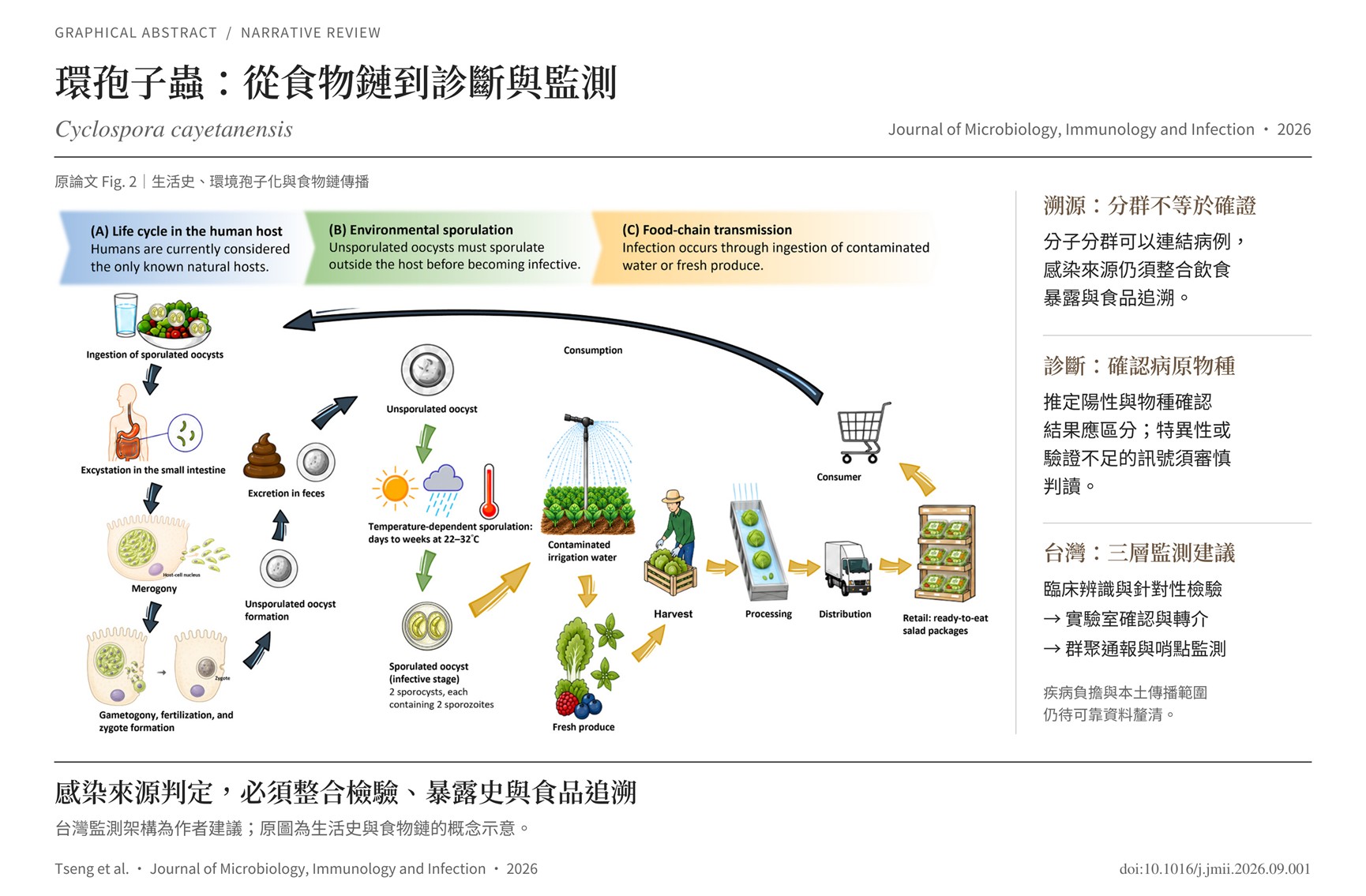
本篇敘述性綜述整合環孢子蟲(Cyclospora cayetanensis)感染的國際疫情、臨床診斷、分子流行病學與治療證據,聚焦食媒性疫情溯源的挑戰與台灣的監測缺口。透過新鮮蔬果相關的代表性疫情,本文分析食品保存期限短、供應鏈複雜及飲食暴露資訊不足,如何增加感染來源追查的難度,並釐清分子檢測與基因分型的應用及限制。分子檢測有助於辨識感染,但應區分推定陽性與物種確認結果;基因分型則可協助辨識病例間的可能關聯,仍須結合病例訪談、食材暴露及食品追溯資訊,才能進一步判定感染來源。針對台灣,本文盤點政府研究、環境調查、臨床文獻與旅遊監測資料,指出現有證據仍不足以估計國內疾病負擔或界定本土傳播範圍,而資料不足並不代表感染不存在。因此,本文提出以臨床辨識與針對性檢驗、標準化實驗室確認及轉介,以及群聚通報與哨點監測為核心的三層架構,建議銜接既有公共衛生與食品安全體系,逐步累積可靠的病例與暴露資訊,為台灣及其他疾病辨識不足的地區,提供改善診斷、監測與感染來源調查的實務方向。


 開關
 首頁
 Facebook
 Instagram
 體系醫院
 中國醫點通